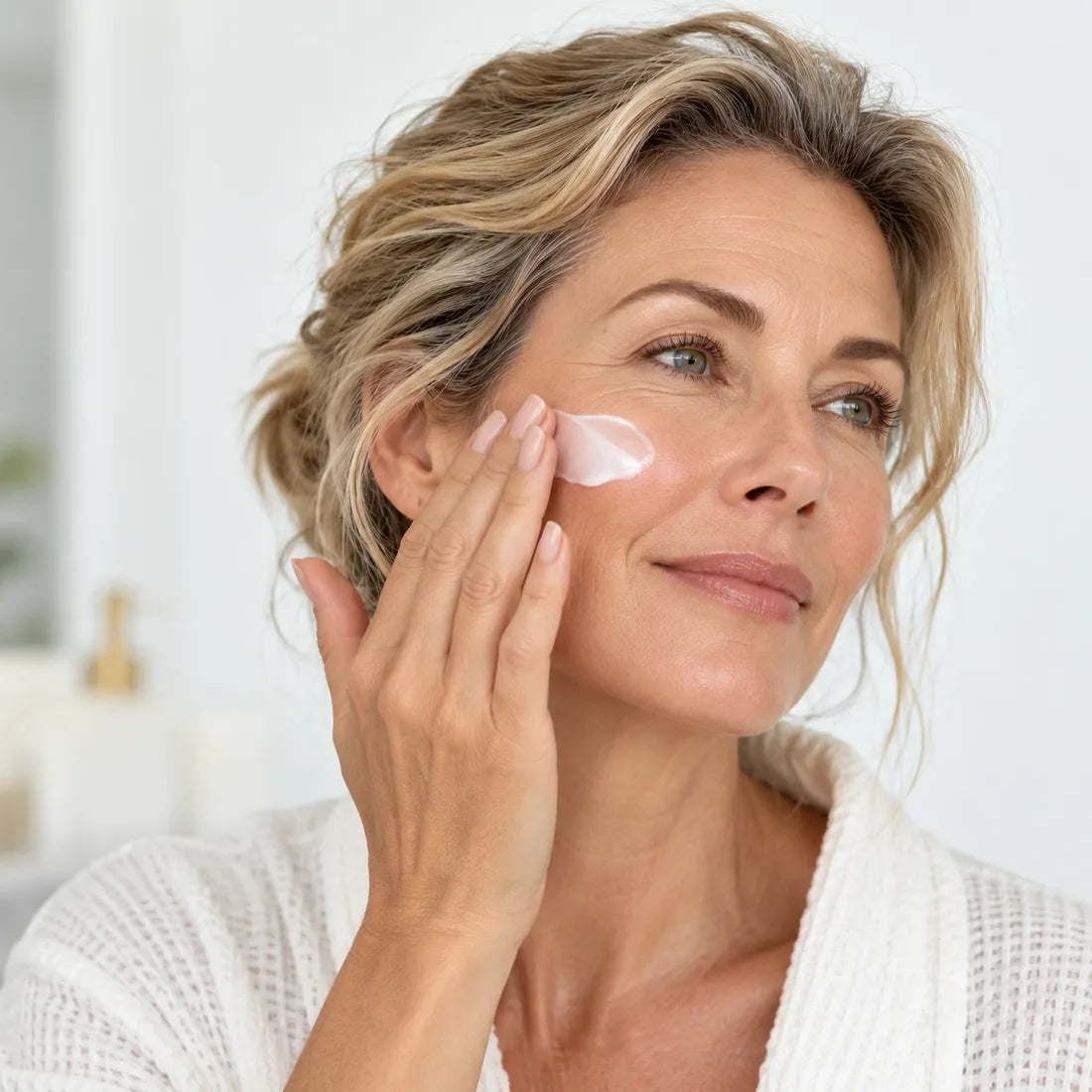
Why your favorite cream suddenly stings in your 40s
It's one of the most common things women tell us: "I've used the same cream for years, and suddenly it stings." Or it feels tight, prickly or just wrong. If that sounds familiar, you're not imagining it, and you're not alone.
Your skin is changing
Skin has estrogen receptors, and estrogen helps support collagen, skin thickness and hydration. When estrogen levels fall in perimenopause and after menopause, research links this to changes many women notice, including thinner and drier skin.[1] The American Academy of Dermatology (AAD) lists dry skin and rashes or easily irritated skin among the skin changes that can come with menopause.[2]
Drier skin, different reactions
When skin is drier, products can feel less comfortable than they used to. The formula didn't change. Your skin did. For dry skin, the AAD advises avoiding products with alcohol, fragrance and retinoids, and choosing gentle, fragrance-free products instead.[3]
The fragrance question
Fragrance is one of the most frequent causes of allergic contact dermatitis, and cosmetics are one of its main sources.[4] An estimated 1.7–4.1% of the general population is sensitized to common fragrance ingredients.[5] That doesn't mean fragrance is a problem for everyone. But if your skin has started to react, it's a sensible first thing to leave out.
What to do now
- Stop using the product that stings. If redness, itching or a rash doesn't go away, see a dermatologist.
- Simplify. Fewer products means fewer ingredients that could bother your skin, and it's easier to find out what works.
- Choose fragrance-free, not just "unscented". Here's the difference.
- Look for moisturizing ingredients such as glycerin and hyaluronic acid, which the AAD mentions for dry skin in menopause.[2]
- Patch test every new product on a small area first.
Why we made Nuelune
We started Nuelune for exactly this moment. Our creams contain no added parfum and no essential oils, and every ingredient is listed on our ingredients page. Start with the Day & Night Set, or read more about why skin changes.
Sources
- Thornton MJ. Estrogens and aging skin. Dermato-Endocrinology. 2013;5(2):264–270. Read the review
- American Academy of Dermatology. Caring for your skin in menopause. aad.org
- American Academy of Dermatology. Dermatologists' top tips for relieving dry skin. aad.org
- Review of fragrance contact allergy. Current Treatment Options in Allergy, 2021. Read the review
- Fragrance contact allergy: a clinical review. American Journal of Clinical Dermatology, 2003. PubMed
This article is for general information only and is not medical advice. If your skin is very itchy, red or painful, please see a doctor or dermatologist.